
RUBIES IN CRYSTAL
Does language hover between my nerve endings and the world, or is language my skin itself?
Sheath of feeling. Words groping to touch air.
Clips
%633 %UTC, %2010, %0:%Oct %Zartwork, Final Cut Express, video stills
Working on a video of a talk (that I videotaped in 2004 for a conference), and need to add some visual interest to it. Found some old exposed film, scratched on some of it, scanned, and then laboriously added images of my paintings, drawings, photos, feathering the edges, one at a time as I found them scattered amidst my computer files. It's on a transparent background, which I hope Final Cut Express picks up on even if Blogspot didn't. And I do hope scrolling these interesting framing of images slowly in the video will hold the viewer's attention through the 18 minutes of the talk. This little bit has taken hours to do. The rest of the images will take at least a week to prepare. Click for a larger version.

A few hours later: the .jpg had a white background, so I opened the .psd file. All the layers were there! I saved them all as a 'freeze frame' and added that as a track in my video. It is unbelievable, but the background is, indeed, transparent.
Here's a QT still, not as good as Apple's Grab application, but I seem to have inadvertently deleted the latter.
You can see I am treating the video frame like a canvas - the coloration, the different layers. When I've finished the video, I will show 'before' and 'after' photos, promise.


Comments
Tea Ceremony
%468 %UTC, %2010, %0:%Oct %Zbeeswax painting, poem paintings, tea ceremony
Tea Ceremony, 2010, 9"x9.5", 23cm x 24cm, india ink, pencils, oils, beeswax.
I came back to this little drawing -a year later turning it into a little painting. Rubbed out some of the green pencil, brushed melted beeswax over it, a little sepia oil colour, wrote into it. I should have left it at this point.
Tea Ceremony
The grace in living,
teapot, tea leaves, steeping.
She bends to pour.
When the waters
washed away the homes.
Clotted blood
of his wounds.
Petals floating on dirges.
Yet laughter of lovers,
her heart of memory.
Landscapes of green
move through us.
Comfort of the gentle
and exact tea ceremony.
Love is everything
the great artist sings.
(c)Brenda Clews, 2009.

Tea Ceremony, 2010, 9"x9.5", 23cm x 24cm, india ink, pencils, oils, beeswax.
This is where I left it after many hours of working. It's glued (with a natural, non-toxic glue) onto another sheet and the writing is scratched through. It spent the night being flattened under many books before this scan.
(Click on images for larger size.)
Slideshow of process from sketch to finished.
'Art of Form' at SPAZ I O dell'arte Gallery
%047 %UTC, %2010, %0:%Oct %Zart, art show, Brenda Clews, Buz Hendricks, editing, FCE, Jazz, sculpture, Theo Willemse, widescreendirect link to video: Theo's 'Art of Form' at SPAZ I O dell'arte
Theo Willemse's sculpture show, 'The Art of Form,' at SPAZ I O dell'arte in Toronto, September, 2010.
Theo Willemse: theowillemse.com
Videoed and edited by Brenda Clews: brendaclews.com
Music by Buz Hendricks: somewhereoffjazzstreet.com
The track is from his song, 'Night Voices,' on "Stories from Midnight Streets": jamendo.com/en/album/25297
_
For this video I culled images from nearly 60 clips taken over 2 days - the reception, and the much quieter next day. The show was magnificent and I hope this short video gives a sense of Theo's work in the wonderful gallery at SPAZ I O dell'arte. Besides the basic editing of multiple clips, I added quite a few filters, the latter to better accompany Buz's fabulous music. Enjoy this memento!
%561 %UTC, %2010, %0:%Oct %Z
Never have I felt such intense inner pressure.
It overwhelms me with increasing presence.
It overwhelms me with increasing presence.
Fruit Bowl
%040 %UTC, %2010, %0:%Oct %ZpoetryVivid orange
rind tears softly
my piercing fingernail,
lying stripped, so
fleshly, sinful to eat.
Like swallowing a thick,
ripe womb for fertilized
ova, section by section.
My tangelo and I tango
sweet juice on the tongue.
Eating the unborn progeny
of plants, I think
of raw food aficionados,
their lust.
rind tears softly
my piercing fingernail,
lying stripped, so
fleshly, sinful to eat.
Like swallowing a thick,
ripe womb for fertilized
ova, section by section.
My tangelo and I tango
sweet juice on the tongue.
Eating the unborn progeny
of plants, I think
of raw food aficionados,
their lust.
%454 %UTC, %2010, %0:%Oct %Z
It is more intense if performed with restraint. Remain on the edge, never give way to easiness.
An emotional and poetic charge requires restraint.
I struggle against language to write.
An emotional and poetic charge requires restraint.
I struggle against language to write.
Interstices
%940 %UTC, %2010, %0:%Oct %ZDeleuze, Descartes, FCE, Freud, Le Pandorien, mirroring, multiplicities, SPAZIO dell'arte, subject, subjectivity, Theo Willemse, videopoem, videopoetry, widescreendirect link: Interstices
A videopoem. I experiment with my own reflection (if I can see myself then I am a Descartian subject, though interspliced with a Deleusian thought-cast).
In the poem I reflect on our reflections of ourselves and how we can't see ourselves except in our art, which reflects us.
The words of the poem:
In the field of an'other,' reflecting on self-reflection. Who are we in our mirror-image? In a gallery of sculpture, do we become still? Stilled, turned-to-stone, despite time, age, change. Like those fizzures, splits, gaps, places of disintegration in the plaster, stone, metal carved and cast about me that occur in smooth moments of presence. Where our lives buckle, crumble, turn backwards to plunge on.
We are subjects who cannot behold ourselves.
We gaze upon ourselves
only
in our art.
Video: Brenda Clews (person/voice in clip, editor of video, poet, ya know the etc.): http://brendaclews.com
Sculpture: Theo Willemse's show, 'The Art of Form' at SPAZ I O dell'arte in September in Toronto: http://theowillemse.com
Music: Le Pandorien, 'Spirale noire op 2,' from his album, "Pandora Moon": http://www.jamendo.com/en/album/44226
A different sort of gallery hop!
_
Stills from the video, showing a little of the process of making it:


The video is displayed in two screens. Both screens show exactly the same video clip. This is the screen on the right. The Final Cut Express filters are: Swing, Color Offset and RGB Balance.

This is the screen on the right, without any filters. This is what I started with.

This is the screen on the left. The Final Cut Express filters are: Noise Dissolve, Indent, Posterize, Vectorize Color, Band Slide, Swing, and Band Slide - 2. It is cropped tighter than the screen on the right.

This is the screen on the left, without any filters. This is what I started with. It is cropped tighter than the screen on the right.
Click on images for larger sizes - you can also go to Picasa to see them together.


Comments (2)
Theo Willemse: The Art of Form
%540 %UTC, %2010, %0:%Sep %ZSculpture of Theo Willemse, SPAZIO dell'arte, Theo Willemse, video of Theo Willemsedirect link: video (some clips) of Theo's show, The Art of Form.

drama of the view through, frame of sculpture, of carved and polished wood
cuts the scene like a tribal rite

forms with the presence of a Seurat, geometric, rounded, stabilized, and earthy, the bulbs of plants, organic, and that stillness of Resnais' Last Year at Marienbad (1961), intrigue of love, the pursuit that never arrives, this room contains

memories of trees, wood from a special and beloved tree, reborn in sculpture
tree of life

sweet friends
a Joycean moment
their bench in the middle of Ulysses
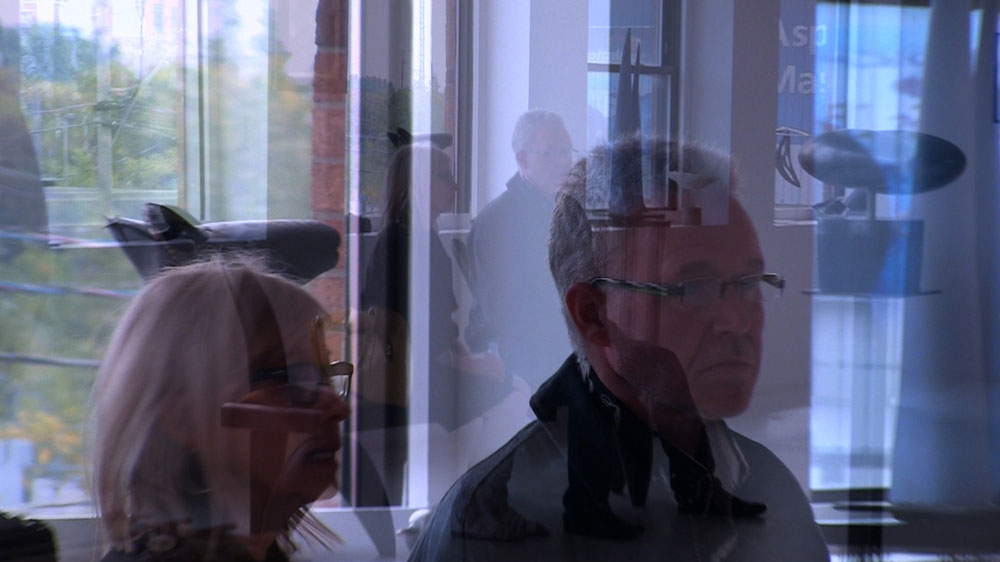
portrait of the artist as a middle-aged man

take a seat, contemplate life, or how to live
for an hour

come to the end of time with me, rest awhile
Slideshow
direct link: a few photos from Theo Willemse's sculpture show, 'The Art of Form,'
at SPAZ I O dell'arte on Sep 23rd, 2010. Photos by my daughter and I. Click through to read my inscriptions.
Sculpture of Theo Willemse
%824 %UTC, %2010, %0:%Sep %ZDutch-Canadian artist, Sculpture of Theo Willemse, SPAZIO dell'arte, Theo Willemse Sculpture of Theo Willemse
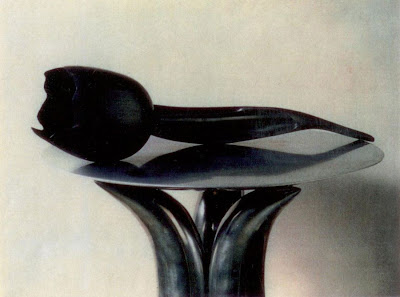
Current Show:
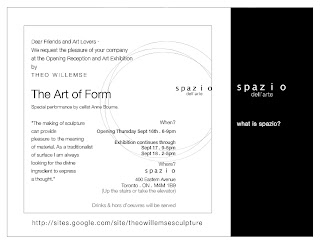
The Art of Form
Opening Thursday Sept 16th, 6-9pm
Exhibition has been extended to Sep 24th, and
perhaps Saturday Sep 25th.
s p a z i o
400 Eastern Avenue
Toronto, ON M4M 1B9
(up the stairs or take the elevator)
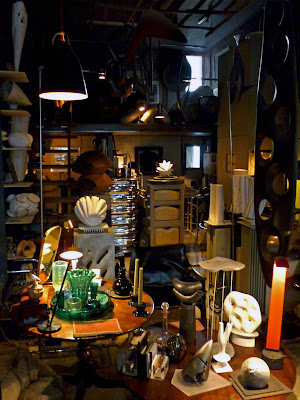
(Theo's studio, August 2010)
Theo Willemse is a Dutch-Canadian artist living in Toronto.
"Theo Willemse's work is as it is. He does not promote theories of his art. Theories are up to the viewer, owner, curator, critic. You may find what inspires you in his sculptures.
While Theo is fairly opague on what he is exploring in his art, believing how the pieces speak to you is enough, that the artist creates and then lets go, having watched his oeuvre develop since 1983, I find I have some perceptions to convey.
His work embodies an intricate interplay of internal dynamics. He will tell you, "It's about the shape, and where the texture of the file shows." Or, "Where it disintegrates slightly, that burn, a moment of dissolution, that's it." "Framing -the stands, pillars, or bases- is important, how the piece is presented visually." His sculptures ask us to touch their forms in three dimensions with our eyes.
You feel your way into his sculptures at a primal level: their curves, gaps, lines, textures, materials. In them you can sense the elements, water, fire, earth. The world of rocks, rivers, trees, plants, flowers wind in them. The wings of birds appear. The world of women and feminine form is here. Phallic shape and wombs underlie some of his works, the natural landscapes of the body wrought in abstracted form in stone, metal, plaster. Some are simple geometric shape, yet always with moments in their rhythms where ruptures occur - an unfinished edge, a sudden buckling of a smooth line, a natural crevice like a knot - in these places we can see where the working is raw.
His sculptures speak in smooth lines, gentle curves, certainties, buckles, pitfalls, moments of indecision, of an intertextuality that echoes our internal life within the sculptural forms of our bodies and our surroundings. Like a continuous spiral from the inner to the outer, we find an aesthetic whose tension consists of the struggle of form, its evolving shapes, and the joy of creating."
Brenda Clews, August 2001
Photo credit: Brenda Clews
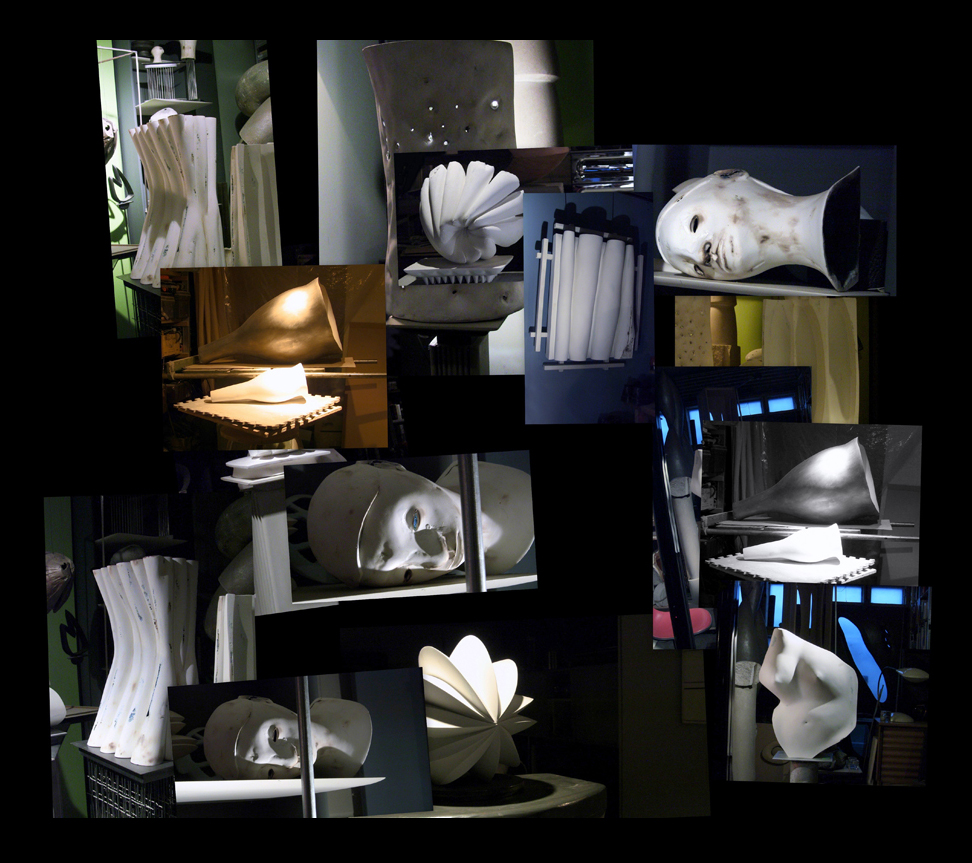
"These sculptures are models for casting in bronze or matrix, which is a gypsom cement that has the quality of marble. The final sculptures are hand-finished.
The originals are fragile. They are sculpted from an industrial grade styrofoam and worked with fine layers of plaster. Then they are honed with files, sandpapers and sometimes patinas. Often Theo leaves traces of the finishing process in the markings, adds an element of decay by burning edges or penetrations to achieve a disintegrating quality to areas of whiteness. The burnings become moments of smouldering and add syncopation to the rhythms of the sculptural forms.
In his studio, the pieces emit a strange stage-set quality, appearing to be solid plaster sculptures yet light as air. If one fell, it might crack. They radiate under the spot lighting with an apparition-like presence that is strong yet delicate. Each one is a labour of months from inception to finished model. They will be destroyed in the casting process." (Brenda Clews, August 2010)
direct link: Theo Willemse -An Artist's Statement
Theo Willemse is a Dutch-Canadian artist living in Toronto, Canada. He is a sculptor working in wood, resin, fibreglass, plaster, aluminum, black patina cement, marble, concrete mixed with marble chips, neo-Matrix, bronze and other materials. He also works occasionally in paint and drawing, creating on paper similar forms to those he sculpts. Slideshows of his recent works, which were shown at SPAZ I O dell'arte in a solo show in September 2010, may be viewed at his website.
This video is an interview conducted with Theo just prior to his September 2010 show at dell'arte.
Interview and video by Brenda Clews.
Photo credit: Kat Bee and Adrian Henderson
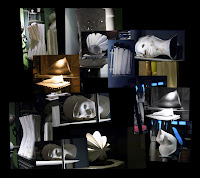


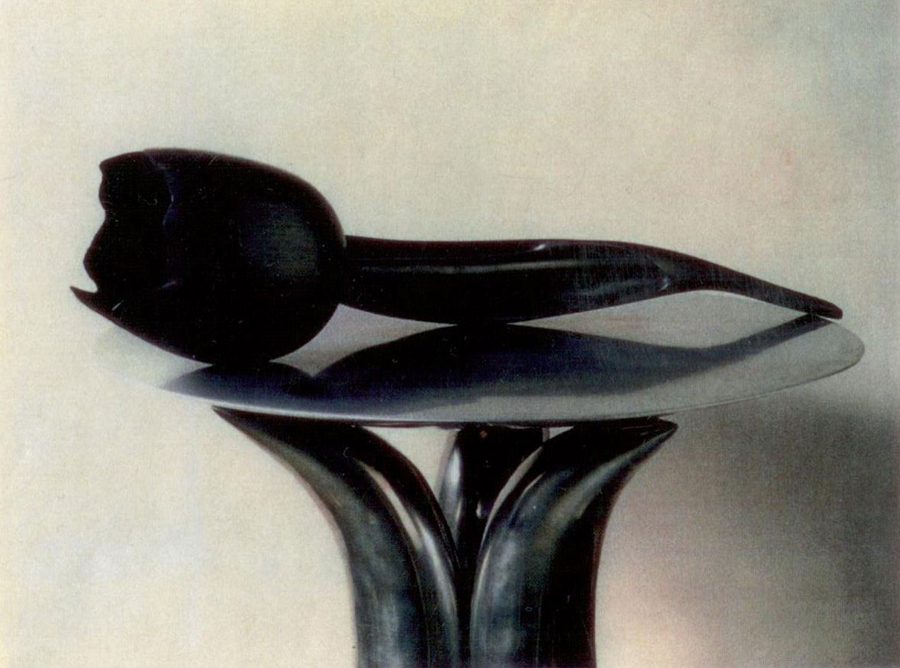
Current Show:
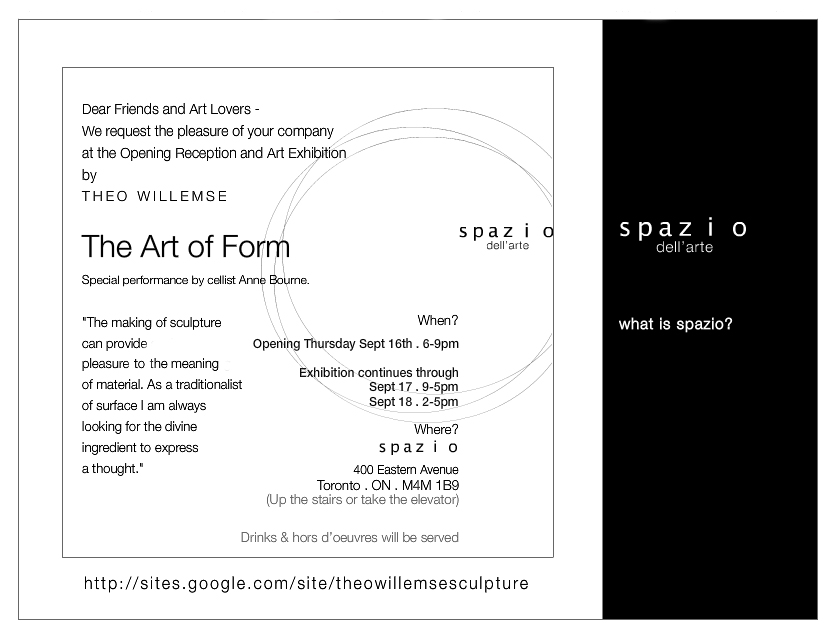
The Art of Form
Opening Thursday Sept 16th, 6-9pm
Exhibition has been extended to Sep 24th, and
perhaps Saturday Sep 25th.
s p a z i o
400 Eastern Avenue
Toronto, ON M4M 1B9
(up the stairs or take the elevator)
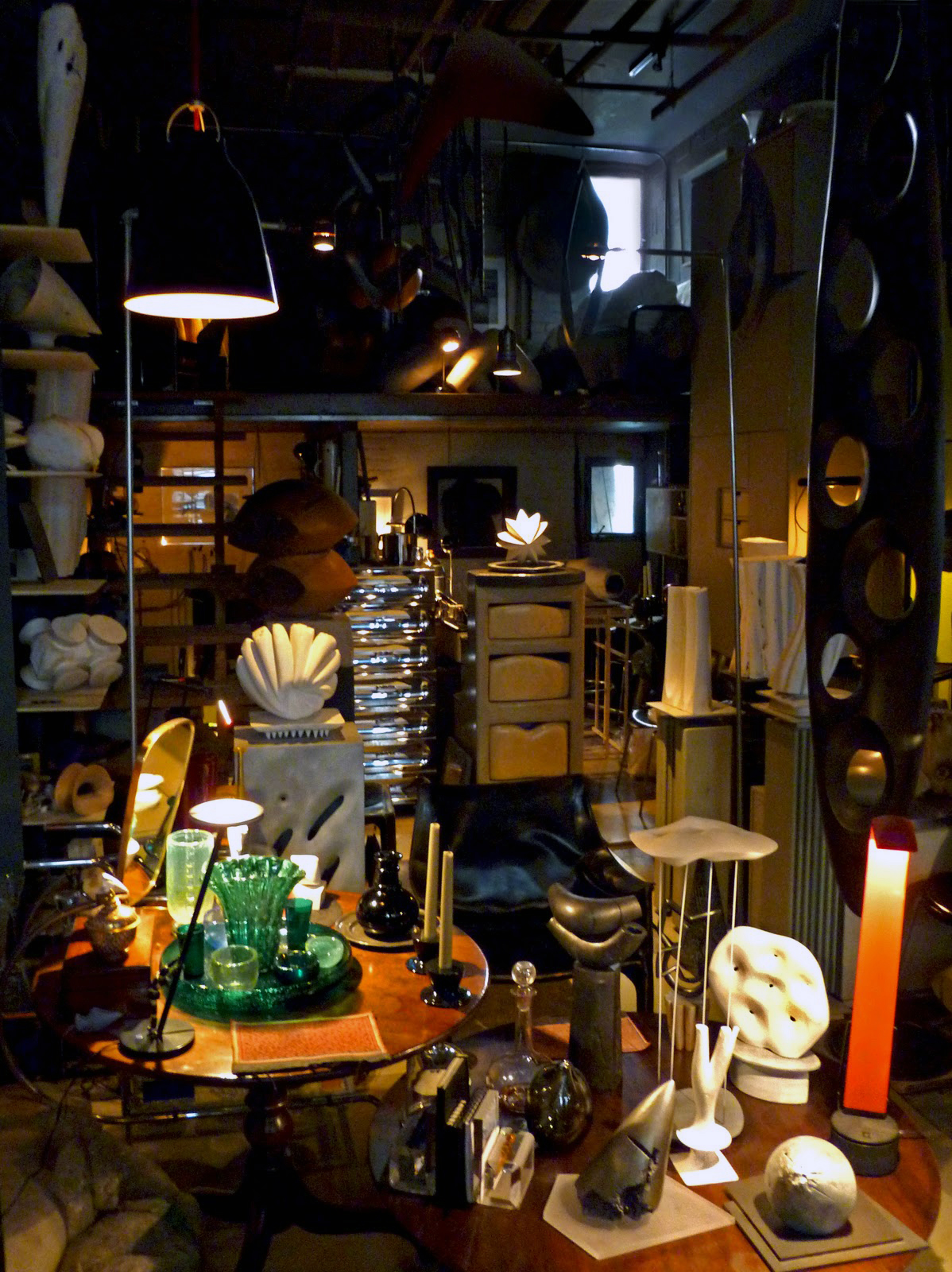
(Theo's studio, August 2010)
Theo Willemse is a Dutch-Canadian artist living in Toronto.
"Theo Willemse's work is as it is. He does not promote theories of his art. Theories are up to the viewer, owner, curator, critic. You may find what inspires you in his sculptures.
While Theo is fairly opague on what he is exploring in his art, believing how the pieces speak to you is enough, that the artist creates and then lets go, having watched his oeuvre develop since 1983, I find I have some perceptions to convey.
His work embodies an intricate interplay of internal dynamics. He will tell you, "It's about the shape, and where the texture of the file shows." Or, "Where it disintegrates slightly, that burn, a moment of dissolution, that's it." "Framing -the stands, pillars, or bases- is important, how the piece is presented visually." His sculptures ask us to touch their forms in three dimensions with our eyes.
You feel your way into his sculptures at a primal level: their curves, gaps, lines, textures, materials. In them you can sense the elements, water, fire, earth. The world of rocks, rivers, trees, plants, flowers wind in them. The wings of birds appear. The world of women and feminine form is here. Phallic shape and wombs underlie some of his works, the natural landscapes of the body wrought in abstracted form in stone, metal, plaster. Some are simple geometric shape, yet always with moments in their rhythms where ruptures occur - an unfinished edge, a sudden buckling of a smooth line, a natural crevice like a knot - in these places we can see where the working is raw.
His sculptures speak in smooth lines, gentle curves, certainties, buckles, pitfalls, moments of indecision, of an intertextuality that echoes our internal life within the sculptural forms of our bodies and our surroundings. Like a continuous spiral from the inner to the outer, we find an aesthetic whose tension consists of the struggle of form, its evolving shapes, and the joy of creating."
Brenda Clews, August 2001
Photo credit: Brenda Clews
"These sculptures are models for casting in bronze or matrix, which is a gypsom cement that has the quality of marble. The final sculptures are hand-finished.
The originals are fragile. They are sculpted from an industrial grade styrofoam and worked with fine layers of plaster. Then they are honed with files, sandpapers and sometimes patinas. Often Theo leaves traces of the finishing process in the markings, adds an element of decay by burning edges or penetrations to achieve a disintegrating quality to areas of whiteness. The burnings become moments of smouldering and add syncopation to the rhythms of the sculptural forms.
In his studio, the pieces emit a strange stage-set quality, appearing to be solid plaster sculptures yet light as air. If one fell, it might crack. They radiate under the spot lighting with an apparition-like presence that is strong yet delicate. Each one is a labour of months from inception to finished model. They will be destroyed in the casting process." (Brenda Clews, August 2010)
direct link: Theo Willemse -An Artist's Statement
Theo Willemse is a Dutch-Canadian artist living in Toronto, Canada. He is a sculptor working in wood, resin, fibreglass, plaster, aluminum, black patina cement, marble, concrete mixed with marble chips, neo-Matrix, bronze and other materials. He also works occasionally in paint and drawing, creating on paper similar forms to those he sculpts. Slideshows of his recent works, which were shown at SPAZ I O dell'arte in a solo show in September 2010, may be viewed at his website.
This video is an interview conducted with Theo just prior to his September 2010 show at dell'arte.
Interview and video by Brenda Clews.
Photo credit: Kat Bee and Adrian Henderson
Comments (4)
Lodela and Pas de deux
%954 %UTC, %2010, %0:%Sep %Zdance film, NFB, Norman McLaren, odela, Pas de deux, Philippe BaylaucqLodela by Philippe Baylaucq, 1996, 26 min 24 s. Direct link: Lodela.
Stark and Sublime Poetic Dance.
Mythic, primal, visionary. I watch Lodela over and over, each time finding more elements in the stark simplicity.
The film is in black and white. The camera lovingly caresses the shadows and planes of the dancers bodies. Camera angles change, from witnessing to being in the centre of their motion looking outward. The choreography is organic, flowing with the natural rhythms of the body. I feel the breeze on the reeds, the storm on the ocean, the planets in the sky. The music is ethereal, gentle. Human voices wake us, and we do not drown, but come to life, emerge. We are born.
The whole of a human life is here, in fetal form, our birth, growth, love, death. The Sisyphean task of our life. Longing, desire. The beauty of the body. Motion, its beauty.
The dancers, Jose Navas and Chi Long, are lithe, muscular, perfect specimens of us, and perfect if opposite reflections of each other, taut as dancers, graceful, expressive, minimalist. A slight reminiscence of Butoh in the expression of the dance - yet there is no horror here, rather a beauty of newness. They are soulmates. They are like strange flowers writhing and crawling and jumping and coiling on the white face of the moon. They are the life in the original amoeba of the planet. We watch the primal cell, the fusion of chromosomes, their dance.
They are at the beginning of everything. A film of the birth of rebirth. They are love.
The final image, where he closes his eyes to awaken as her is profound.
This film by Philippe Baylaucq is poetry. A masterpiece.
And then this, oh Duchamp! Especially the ending, exquisitely filmed and edited.
Pas de deux by Norman McLaren, 1968, 13 min 22 s. Direct link: Pas de deux.
Oct 2026
Sep 2026
Jul 2026
Apr 2025
Feb 2025
Jun 2024
Apr 2024
Aug 2023
Oct 2022
May 2022
Oct 2021
Sep 2021
Jul 2021
May 2021
Jan 2021
Oct 2020
Aug 2020
Jul 2020
Jun 2020
May 2020
Dec 2019
Sep 2019
Aug 2019
Jul 2019
May 2019
Apr 2019
Feb 2019
Jan 2019
Nov 2018
Sep 2018
Aug 2018
Jul 2018
May 2018
Apr 2018
Mar 2018
Feb 2018
Jan 2018
Dec 2017
Nov 2017
Oct 2017
Sep 2017
Aug 2017
Jul 2017
Jun 2017
May 2017
Apr 2017
Mar 2017
Feb 2017
Jan 2017
Dec 2016
Nov 2016
Oct 2016
Sep 2016
Aug 2016
Jul 2016
Jun 2016
May 2016
Apr 2016
Mar 2016
Feb 2016
Jan 2016
Dec 2015
Nov 2015
Oct 2015
Sep 2015
Aug 2015
Jul 2015
Jun 2015
May 2015
Apr 2015
Mar 2015
Feb 2015
Jan 2015
Dec 2014
Nov 2014
Oct 2014
Sep 2014
Aug 2014
Jul 2014
Jun 2014
May 2014
Apr 2014
Mar 2014
Feb 2014
Jan 2014
Dec 2013
Nov 2013
Oct 2013
Sep 2013
Aug 2013
Jul 2013
Jun 2013
May 2013
Apr 2013
Mar 2013
Feb 2013
Jan 2013
Dec 2012
Nov 2012
Oct 2012
Sep 2012
Aug 2012
Jul 2012
Jun 2012
May 2012
Apr 2012
Mar 2012
Feb 2012
Jan 2012
Dec 2011
Nov 2011
Oct 2011
Sep 2011
Aug 2011
Jul 2011
Jun 2011
May 2011
Apr 2011
Mar 2011
Feb 2011
Jan 2011
Dec 2010
Nov 2010
Oct 2010
Sep 2010
Aug 2010
Jul 2010
Jun 2010
May 2010
Apr 2010
Mar 2010
Feb 2010
Jan 2010
Dec 2009
Nov 2009
Oct 2009
Sep 2009
Aug 2009
Jul 2009
Jun 2009
May 2009
Apr 2009
Mar 2009
Feb 2009
Jan 2009
Dec 2008
Nov 2008
Oct 2008
Sep 2008
Aug 2008
Jul 2008
Jun 2008
May 2008
Apr 2008
Mar 2008
Feb 2008
Jan 2008
Dec 2007
Nov 2007
Oct 2007
Sep 2007
Aug 2007
Jul 2007
Jun 2007
May 2007
Apr 2007
Mar 2007
Feb 2007
Jan 2007
Dec 2006
Nov 2006
Oct 2006
Sep 2006
Aug 2006
Jul 2006
Jun 2006
May 2006
Apr 2006
Mar 2006
Feb 2006
Jan 2006
Dec 2005
Nov 2005
Oct 2005
Sep 2005
Aug 2005
Jul 2005
Jun 2005
May 2005
Apr 2005
Mar 2005
Feb 2005
Jan 2005
Sep 2004
Jun 2004
May 2004
Oct 2003
Sep 2026
Jul 2026
Apr 2025
Feb 2025
Jun 2024
Apr 2024
Aug 2023
Oct 2022
May 2022
Oct 2021
Sep 2021
Jul 2021
May 2021
Jan 2021
Oct 2020
Aug 2020
Jul 2020
Jun 2020
May 2020
Dec 2019
Sep 2019
Aug 2019
Jul 2019
May 2019
Apr 2019
Feb 2019
Jan 2019
Nov 2018
Sep 2018
Aug 2018
Jul 2018
May 2018
Apr 2018
Mar 2018
Feb 2018
Jan 2018
Dec 2017
Nov 2017
Oct 2017
Sep 2017
Aug 2017
Jul 2017
Jun 2017
May 2017
Apr 2017
Mar 2017
Feb 2017
Jan 2017
Dec 2016
Nov 2016
Oct 2016
Sep 2016
Aug 2016
Jul 2016
Jun 2016
May 2016
Apr 2016
Mar 2016
Feb 2016
Jan 2016
Dec 2015
Nov 2015
Oct 2015
Sep 2015
Aug 2015
Jul 2015
Jun 2015
May 2015
Apr 2015
Mar 2015
Feb 2015
Jan 2015
Dec 2014
Nov 2014
Oct 2014
Sep 2014
Aug 2014
Jul 2014
Jun 2014
May 2014
Apr 2014
Mar 2014
Feb 2014
Jan 2014
Dec 2013
Nov 2013
Oct 2013
Sep 2013
Aug 2013
Jul 2013
Jun 2013
May 2013
Apr 2013
Mar 2013
Feb 2013
Jan 2013
Dec 2012
Nov 2012
Oct 2012
Sep 2012
Aug 2012
Jul 2012
Jun 2012
May 2012
Apr 2012
Mar 2012
Feb 2012
Jan 2012
Dec 2011
Nov 2011
Oct 2011
Sep 2011
Aug 2011
Jul 2011
Jun 2011
May 2011
Apr 2011
Mar 2011
Feb 2011
Jan 2011
Dec 2010
Nov 2010
Oct 2010
Sep 2010
Aug 2010
Jul 2010
Jun 2010
May 2010
Apr 2010
Mar 2010
Feb 2010
Jan 2010
Dec 2009
Nov 2009
Oct 2009
Sep 2009
Aug 2009
Jul 2009
Jun 2009
May 2009
Apr 2009
Mar 2009
Feb 2009
Jan 2009
Dec 2008
Nov 2008
Oct 2008
Sep 2008
Aug 2008
Jul 2008
Jun 2008
May 2008
Apr 2008
Mar 2008
Feb 2008
Jan 2008
Dec 2007
Nov 2007
Oct 2007
Sep 2007
Aug 2007
Jul 2007
Jun 2007
May 2007
Apr 2007
Mar 2007
Feb 2007
Jan 2007
Dec 2006
Nov 2006
Oct 2006
Sep 2006
Aug 2006
Jul 2006
Jun 2006
May 2006
Apr 2006
Mar 2006
Feb 2006
Jan 2006
Dec 2005
Nov 2005
Oct 2005
Sep 2005
Aug 2005
Jul 2005
Jun 2005
May 2005
Apr 2005
Mar 2005
Feb 2005
Jan 2005
Sep 2004
Jun 2004
May 2004
Oct 2003